📋 This article is based on 6 peer-reviewed studies from PubMed. Last updated: March 2026.
INTRODUCTION
This guide provides an evidence-based overview of the recovery process following cystolitholapaxy, a surgical procedure used to fragment and remove bladder stones. While transurethral approaches (TUCL) are common, the sources focus heavily on percutaneous cystolitholapaxy (PCCL), a minimally invasive alternative preferred for large stone burdens or complex urinary anatomy.
1. Overview: How long does recovery take?
Recovery from cystolitholapaxy is generally shorter and associated with less morbidity than traditional open surgery. Because endoscopic approaches avoid large abdominal incisions, patients typically experience a faster return to baseline health. Most patients are discharged within 24 to 48 hours, with some procedures performed in an outpatient setting.
2. Hospital stay duration
Hospital stays vary based on the surgical approach and patient complexity:
- Outpatient/Observation: Approximately 48% of patients in a single-surgeon series were discharged the same day, while 40% required observation for less than 24 hours.
- Percutaneous Approach (PCCL): Median stays are reported between 1.1 and 1.5 days for patients with complex reconstructions. For large stones treated without fluoroscopy, the mean stay was 2.2 days.
- Comparison to Open Surgery: Hospitalization is significantly shorter for endourological procedures (mean 2.6 days) compared to open cystolithotomy (mean 4.8 days).
3. Catheter removal timing
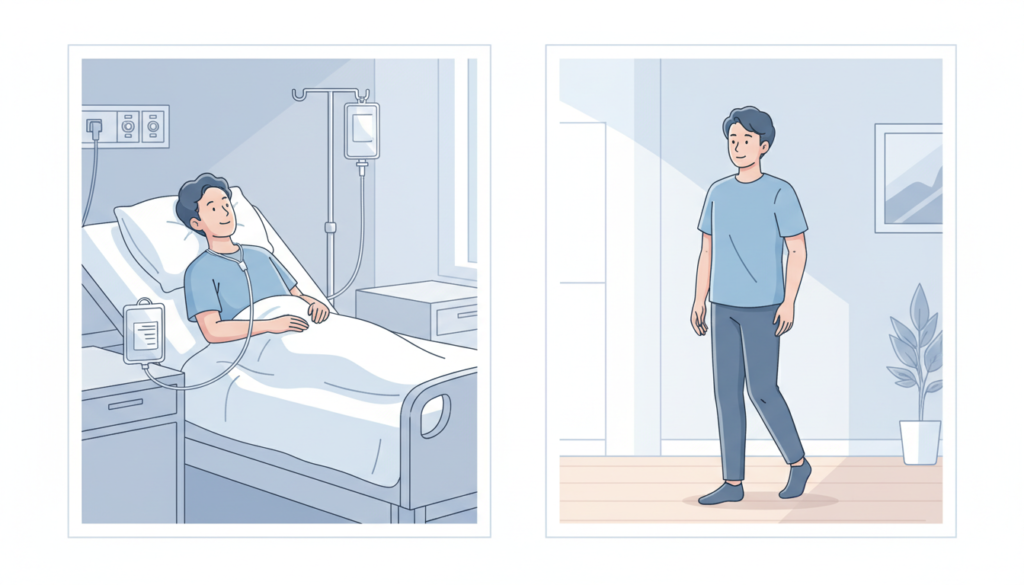
Postoperative bladder drainage is necessary to allow the bladder to heal and ensure proper emptying:
- Standard Timing: A urethral Foley or suprapubic tube (SPT) is typically left for 5–7 days.
- Reconstructed/Augmented Bladders: In patients with bowel-augmented bladders, the SPT is often left for 2 weeks to allow the bowel segment adequate time to heal.
- Early Removal: In some series focusing on large stones, urethral catheters were removed as early as 1.2 days post-surgery. In specific pediatric cases for small stones (<1 cm), postoperative catheters may not be required at all.
- Long-term Drainage: For patients with Exstrophy–Epispadias Complex (EEC), the SP tube may be maintained for 4 weeks.
4. Return to daily activities & work
Because PCCL is minimally invasive, it allows for a “short convalescence” compared to open procedures. Many procedures are successfully managed as outpatient surgery. While specific return-to-work dates depend on individual recovery, the use of small-caliber instruments minimizes trauma, facilitating a quicker return to daily routines.
Read: What is Cystolitholapaxy?
5. Postoperative symptoms (what is normal)
Patients should expect certain mild symptoms during the initial recovery phase:
- Incisional Pain: Typically managed with over-the-counter medications like acetaminophen and nonsteroidal anti-inflammatory drugs (NSAIDs); opioids are rarely necessary.
- Hematuria: Mild, self-controlled blood in the urine is common.
- Voiding Discomfort: Transient edema or the passage of tiny remaining gravel can cause bothersome dysuria (painful urination).
6. Warning signs requiring medical attention
While complications are infrequent, patients should contact their medical team if they experience:
- Uncontrolled Hemorrhage: Significant bleeding, either through the urine or the cystostomy tract.
- High Fever: A fever >38°C may indicate a postoperative urinary tract infection or sepsis.
- Persistent Leakage: Continual urinary leakage from the suprapubic puncture site after the catheter is removed.
- Acute Abdominal Pain: Severe abdominal discomfort or distention, which could signal a rare bladder perforation.
7. Recovery in special populations
Recovery protocols are often tailored for specific groups:
- Pediatric Patients: Endourological management offers shorter hospital stays than open surgery but requires careful monitoring for urethral strictures (scarring), which are more common in boys following transurethral manipulation.
- Reconstructed Bladders: Patients with bladder augmentations or continent diversions are at a higher risk for stone recurrence (up to 44% in adults). They often require longer catheterization and regular bladder irrigations to evacuate mucus and debris.
- Exstrophy–Epispadias Complex (EEC): These patients benefit significantly from percutaneous approaches, as open surgery carries a much higher risk of vesicocutaneous fistula formation (up to 45.45% in one study).
8. Factors affecting recovery time
Several variables can influence how quickly a patient recovers:
- Stone Burden: Larger stone volumes (multi-centimeter) increase operative time and complexity, which can occasionally require staged procedures.
- Surgical Approach: Percutaneous techniques generally result in faster recovery and fewer complications than open surgery for large or multiple stones.
- Anatomical Complexity: Prior reconstructions or severe BPH may necessitate longer catheter durations to ensure the bladder empties completely.
9. Follow-up schedule
Regular monitoring is essential to confirm the patient is “stone-free”:
- Short-term: A follow-up visit is often scheduled 2 weeks post-surgery to evaluate the suprapubic entry site and confirm stone clearance via X-ray or ultrasound. Another common checkpoint is at 4 weeks.
- Long-term: Patients with high-risk conditions, such as EEC, often undergo annual renal and bladder ultrasounds for life to monitor for stone recurrence.
- Pediatric Recommendation: Close clinical and ultrasound follow-up is recommended during the first postoperative week to detect any delayed complications like missed perforations.
References
- Al-Marhoon, M. S., Sarhan, O. M., Awad, B. A., Helmy, T., Ghali, A., & Dawaba, M. S. (2009). Comparison of endourological and open cystolithotomy in the management of bladder stones in children. The Journal of Urology, 181(6), 2684–2688.
- Almesned, R. K., Binjawhar, A., Altaweel, W., & Alomar, M. (2025). Percutaneous cystolitholapaxy in reconstructed bladder through the bowel segment. Urology Annals, 17(1), 64–67.
- Gamal, W., Eldahshoury, M., Hussein, M., & Hammady, A. (2013). Cystoscopically guided percutaneous suprapubic cystolitholapaxy in children. International Urology and Nephrology, 45(4), 933–937.
- Lee, M. S., Sledge, T. R., Seyer, A. K., Qi, R., & Koo, K. (2025). How I do it: percutaneous cystolitholapaxy for bladder stones with complex lower urinary tract anatomy. Canadian Journal of Urology, 32(4), 325–333.
- Metwally, A. H., Sherief, M. H., & Elkoushy, M. A. (2016). Safety and efficacy of cystoscopically guided percutaneous suprapubic cystolitholapaxy without fluoroscopic guidance. Arab Journal of Urology, 14(3), 211–215.
- Yang, J., Heap, D., Maxon, V., Robey, C., Maruf, M., Michel, C., Di Carlo, H. N., Gearhart, J. P., & Crigger, C. B. (2025). Percutaneous cystolitholapaxy and open cystolithotomy in exstrophy–epispadias complex: A comparative approach to bladder stone management. Journal of Endourology, 39(11), 1172–1180.